

Why sorting by batting average is not a lineup plan
Last updated: September 1, 2026
Batting average does not distinguish a single from a home run, count a walk, describe speed, or show a sacrifice. Sorting one column also makes every lineup slot ask the same question. Real batting-order jobs are different: reach base, extend the inning, drive the ball, produce with runners aboard, or turn the lineup over.
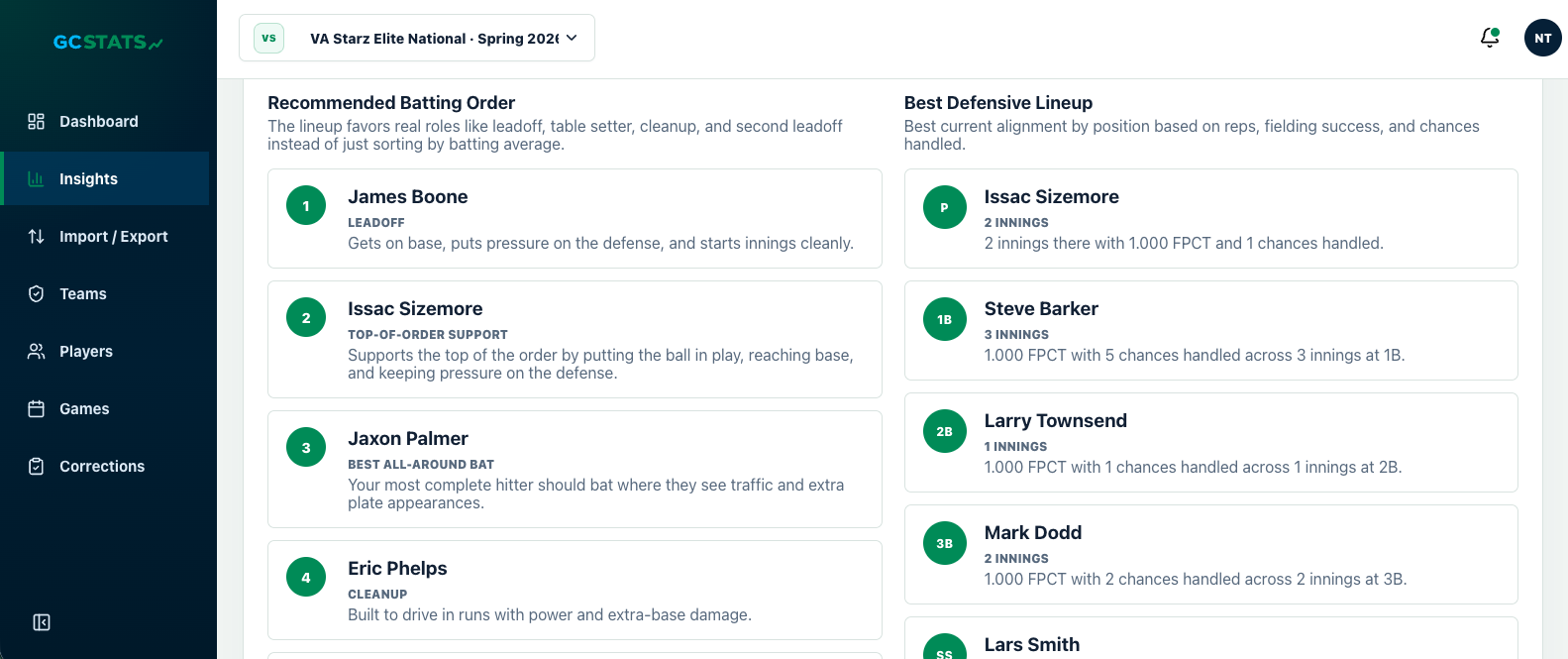
The GC Stats approach is a first-pass recommendation. It is designed to show why a player fits a slot so a coach can accept, move, or reject the suggestion.
Step 1: decide whether the sample deserves weight
GC Stats requires at least three plate appearances for its normal lineup candidate pool. When too few hitters meet that mark, the product falls back to available hitters instead of pretending the roster has no answer. Three plate appearances is only an eligibility floor, not proof that a rate is stable.
- Prefer a season or meaningful recent window over one isolated game.
- Compare plate appearances so a perfect one-for-one line does not outrank sustained production without context.
- Review corrections and missing games before asking the data to settle a close call.
- Use recent evidence deliberately when an injury, role change, or swing adjustment makes the full season less representative.
Step 2: define what each batting-order job needs
| Slot | Role | Evidence emphasized | Coach check |
|---|---|---|---|
| 1 | Leadoff | OBP, speed, contact, runs | Can she handle frequent high-pressure plate appearances? |
| 2 | Table setter | OBP, QAB, contact, sacrifices | Can she execute the team's move-runner plan? |
| 3 | Best all-around bat | OPS, AVG, OBP, RBI production | Is she getting enough chances with runners aboard? |
| 4 | Cleanup | SLG, extra-base hits, home runs, RBI | Does the power hold up against this matchup? |
| 5 | Run producer | OPS, RBI, RISP results, QAB | Who protects the cleanup hitter and sustains the inning? |
| 6-7 | Secondary offense | AVG, OPS, contact, QAB | Which sequence avoids stacking similar weaknesses? |
| 8 | Bottom-order pressure | Sacrifice skill, speed, OBP, contact | Can this player create an extra decision for the defense? |
| 9 | Second leadoff | OBP, speed, QAB, sacrifices | Can she turn the lineup over for the top? |
These are the role categories tested in GC Stats Coach Insights. They are evidence priorities, not universal softball laws. Team strategy and roster shape can justify a different order.
Step 3: work through a sanitized roster
The GC Stats regression fixture includes fictional hitters with deliberately different profiles. In the tested first five slots, the recommendation is Lily, Ava, Mia, Zoey, and Emma. The value is not the names. It is whether the reasoning can be audited.
1. Lily, leadoff
Lily has a .583 OBP in the sample, plus six runs and six stolen bases. Her profile creates opportunities for the hitters behind her.
2. Ava, table setter
Ava's .286 AVG is not the selling point. Her .500 QAB rate and three sacrifices fit the job of extending or advancing the inning.
3. Mia, best all-around
Mia leads the sample with a .600 AVG, .667 OBP, and 1.767 OPS. She combines getting on base with extra-base production.
4. Zoey, cleanup
Zoey's two home runs, one double, and 1.222 SLG make her the clearest power profile even though Mia has the higher AVG.
5. Emma, run producer
Emma's .545 QAB rate and six RBIs give the recommendation a process and production case beyond her .375 AVG.
Step 4: challenge the first draft
Before printing the card, ask what the stat line cannot know. The opposing pitcher may change which hitters see the ball well. One player may be returning from injury. A young hitter may execute better with less pressure lower in the order. A tournament substitution plan may make two nearly equal players more valuable in a different sequence.
- Matchup: Handedness, velocity, movement, and prior quality of contact can matter more than a small rate difference.
- Availability: Injury, fatigue, pitch-count limits, and defensive assignments can change the best complete lineup.
- Team strategy: A team that rarely bunts should not overvalue sacrifice totals in the second slot.
- Measurement limits: Runners-in-scoring-position stats can be a practical proxy for situations such as a runner on third, but they are not the same split.
- Player development: The best order for winning one game may not be the best order for developing a roster across a season.
Step 5: make every change explainable
Write one sentence for each non-obvious choice. “Lily leads off because her OBP and speed create the most top-of-order opportunities” gives the staff something concrete to review. “Emma stays fifth because her QAB and RBI profile supports the power hitter” does the same.
If the coach overrides a suggestion, record the reason with the same discipline. “Move Mia to leadoff because she is seeing today's pitcher best” is a valid coaching decision. The method succeeds when it improves the conversation, not when every generated slot survives unchanged.
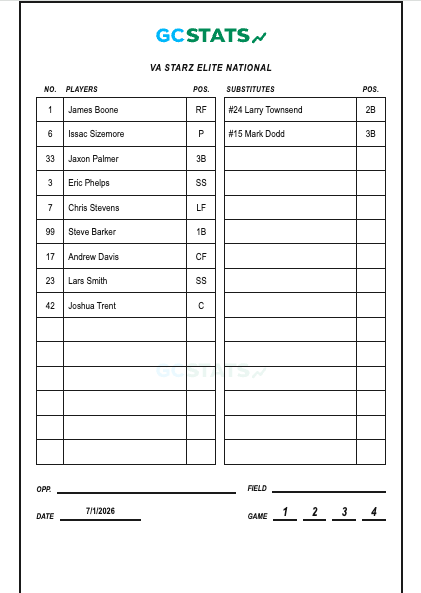
A five-minute pregame checklist
- Confirm the latest completed game is included and corrected.
- Check plate-appearance sample sizes and any major recent change.
- Identify the strongest candidates for leadoff, all-around production, and cleanup.
- Build the remaining order to support those roles and avoid stacking the same weakness.
- Apply matchup, health, development, and substitution context.
- Explain each close call, then print or share the final card.
That process is more defensible than sorting AVG, and it is still fast enough to use between games.